miércoles, 28 de agosto de 2019

What is being vegetarian?


Becoming a vegetarian
becoming a vegetarian
Published: October, 2009
People become vegetarians for many reasons, including health, religious convictions, concerns about animal welfare or the use of antibiotics and hormones in livestock, or a desire to eat in a way that avoids excessive use of environmental resources. Some people follow a largely vegetarian diet because they can't afford to eat meat. Becoming a vegetarian has become more appealing and accessible, thanks to the year-round availability of fresh produce, more vegetarian dining options, and the growing culinary influence of cultures with largely plant-based diets.
Approximately six to eight million adults in the United States eat no meat, fish, or poultry, according to a Harris Interactive poll commissioned by the Vegetarian Resource Group, a nonprofit organization that disseminates information about vegetarianism. Several million more have eliminated red meat but still eat chicken or fish. About two million have become vegans, forgoing not only animal flesh but also animal-based products such as milk, cheese, eggs, and gelatin.
Traditionally, research into vegetarianism focused mainly on potential nutritional deficiencies, but in recent years, the pendulum has swung the other way, and studies are confirming the health benefits of meat-free eating. Nowadays, plant-based eating is recognized as not only nutritionally sufficient but also as a way to reduce the risk for many chronic illnesses. According to the American Dietetic Association, "appropriately planned vegetarian diets, including total vegetarian or vegan diets, are healthful, nutritionally adequate, and may provide health benefits in the prevention and treatment of certain diseases."
"Appropriately planned" is the operative term. Unless you follow recommended guidelines on nutrition, fat consumption, and weight control, becoming a vegetarian won't necessarily be good for you. A diet of soda, cheese pizza, and candy, after all, is technically "vegetarian." For health, it's important to make sure that you eat a wide variety of fruits, vegetables, and whole grains. It's also vital to replace saturated and trans fats with good fats, such as those found in nuts, olive oil, and canola oil. And always keep in mind that if you eat too many calories, even from nutritious, low-fat, plant-based foods, you'll gain weight. So it's also important to practice portion control, read food labels, and engage in regular physical activity.
You can get many of the health benefits of being vegetarian without going all the way. For example, a Mediterranean eating pattern — known to be associated with longer life and reduced risk of several chronic illnesses — features an emphasis on plant foods with a sparing use of meat. Even if you don't want to become a complete vegetarian, you can steer your diet in that direction with a few simple substitutions, such as plant-based sources of protein — beans or tofu, for example — or fish instead of meat a couple of times a week.
Only you can decide whether a vegetarian diet is right for you. If better health is your goal, here are some things to consider.

Varieties of vegetarians

Strictly speaking, vegetarians are people who don't eat meat, poultry, or seafood. But people with many different dietary patterns call themselves vegetarians, including the following:
Vegans (total vegetarians): Do not eat meat, poultry, fish, or any products derived from animals, including eggs, dairy products, and gelatin.
Lacto-ovo vegetarians: Do not eat meat, poultry, or fish, but do eat eggs and dairy products.
Lacto vegetarians: Eat no meat, poultry, fish, or eggs, but do consume dairy products.
Ovo vegetarians: Eat no meat, poultry, fish, or dairy products, but do eat eggs.
Partial vegetarians: Avoid meat but may eat fish (pesco-vegetarian, pescatarian) or poultry (pollo-vegetarian).

Can becoming a vegetarian protect you against major diseases?

Maybe. Compared with meat eaters, vegetarians tend to consume less saturated fat and cholesterol and more vitamins C and E, dietary fiber, folic acid, potassium, magnesium, and phytochemicals (plant chemicals), such as carotenoids and flavonoids. As a result, they're likely to have lower total and LDL (bad) cholesterol, lower blood pressure, and lower body mass index (BMI), all of which are associated with longevity and a reduced risk for many chronic diseases.
But there still aren't enough data to say exactly how a vegetarian diet influences long-term health. It's difficult to tease out the influence of vegetarianism from other practices that vegetarians are more likely to follow, such as not smoking, not drinking excessively, and getting adequate exercise. But here's what some of the research has shown so far:
Heart disease. There's some evidence that vegetarians have a lower risk for cardiac events (such as a heart attack) and death from cardiac causes. In one of the largest studies — a combined analysis of data from five prospective studies involving more than 76,000 participants published several years ago — vegetarians were, on average, 25% less likely to die of heart disease. This result confirmed earlier findings from studies comparing vegetarian and nonvegetarian Seventh-day Adventists (members of this religious group avoid caffeine and don't drink or smoke; about 40% are vegetarians). In another study involving 65,000 people in the Oxford cohort of the European Prospective Investigation into Cancer and Nutrition (EPIC-Oxford), researchers found a 19% lower risk of death from heart disease among vegetarians. However, there were few deaths in either group, so the observed differences may have been due to chance.
For heart protection, it's best to choose high-fiber whole grains and legumes, which are digested slowly and have a low glycemic index — that is, they help keep blood sugar levels steady. Soluble fiber also helps reduce cholesterol levels. Refined carbohydrates and starches like potatoes, white rice, and white-flour products cause a rapid rise in blood sugar, which increases the risk of heart attack and diabetes (a risk factor for heart disease).
Nuts are also heart-protective. They have a low glycemic index and contain many antioxidants, vegetable protein, fiber, minerals, and healthy fatty acids. The downside: nuts pack a lot of calories, so restrict your daily intake to a small handful (about an ounce). The upside: because of their fat content, even a small amount of nuts can satisfy the appetite.
Walnuts, in particular, are a rich source of omega-3 fatty acids, which have many health benefits. Even so, fish are the best source of omega-3s, and it's not clear whether plant-derived omega-3s are an adequate substitute for fish in the diet. One study suggests that omega-3s from walnuts and fish both work to lower heart disease risk, but by different routes. Walnut omega-3s (alpha-linolenic acid, or ALA) help reduce total cholesterol and LDL (bad) cholesterol, while omega-3s from fish (eicosapentaenoic acid, or EPA, and docosahexaenoic acid, or DHA) lower triglycerides and raise HDL (good) cholesterol levels.
Cancer. Hundreds of studies suggest that eating lots of fruits and vegetables can reduce the risk of developing certain cancers, and there's evidence that vegetarians have a lower incidence of cancer than nonvegetarians do. But the differences aren't large. A vegetarian diet can make it easier to get the recommended minimum of five daily servings of fruits and vegetables, but a purely vegetarian diet is not necessarily better than a plant-based diet that also includes fish or poultry. For example, in a pooled analysis of data from the Oxford Vegetarian Study and EPIC-Oxford, fish-eaters had a lower risk of certain cancers than vegetarians.
If you stop eating red meat (whether or not you become a vegetarian), you'll eliminate a risk factor for colon cancer. It's not clear whether avoiding all animal products reduces the risk further. Vegetarians usually have lower levels of potentially carcinogenic substances in their colons, but studies comparing cancer rates in vegetarians and nonvegetarians have shown inconsistent results.
Type 2 diabetes. Research suggests that a predominantly plant-based diet can reduce the risk for type 2 diabetes. In studies of Seventh-day Adventists, vegetarians' risk of developing diabetes was half that of nonvegetarians, even after taking BMI into account. The Harvard-based Women's Health Study found a similar correlation between eating red meat (especially processed meats, such as bacon and hot dogs) and diabetes risk, after adjusting for BMI, total calorie intake, and exercise.

What about bone health?

Some women are reluctant to try a vegetarian diet — especially one that doesn't include calcium-rich dairy products — because they're concerned about osteoporosis. Lacto-ovo vegetarians (see "Varieties of vegetarians") consume at least as much calcium as meat-eaters, but vegans typically consume less. In the EPIC-Oxford study, 75% of vegans got less than the recommended daily amount of calcium, and vegans in general had a relatively high rate of fractures. But vegans who consumed at least 525 milligrams of calcium per day were not especially vulnerable to fractures.
Certain vegetables can supply calcium, including bok choy, broccoli, Chinese cabbage, collards, and kale. (Spinach and Swiss chard, which also contain calcium, are not such good choices, because along with the calcium they have oxalates, which make it harder for the body to absorb calcium.) Moreover, the high potassium and magnesium content of fruits and vegetables reduces blood acidity, lowering the urinary excretion of calcium.
People who follow a vegetarian diet and especially a vegan diet may be at risk of getting insufficient vitamin D and vitamin K, both needed for bone health. Although green leafy vegetables contain some vitamin K, vegans may also need to rely on fortified foods, including some types of soy milk, rice milk, organic orange juice, and breakfast cereals. They may also want to consider taking a vitamin D supplement.

Selected resources

Becoming a vegetarian requires planning and knowledge of plant-based nutrition. Here are some resources that can help:
American Dietetic Association
www.eatright.org
The Vegetarian Resource Group
www.vrg.org
Vegetarian Society of the United Kingdom
www.vegsoc.org

What about the health risks of being vegetarian?

Concerns about vegetarian diets have focused mainly on the following nutrients:
Protein. Research shows that lacto-ovo vegetarians generally get the recommended daily amount of protein, which is easily obtained from dairy products and eggs. (Women need about 0.4 grams of protein per pound of body weight per day. Because the protein in vegetables is somewhat different from animal protein, vegans may need 0.45 grams of protein per pound of body weight per day.) There are many plant sources that can help vegans meet their protein needs, including peas, beans, lentils, chickpeas, seeds, nuts, soy products, and whole grains (for example, wheat, oats, barley, and brown rice). Vegetarians used to be told that they had to combine "complementary" plant proteins (rice with beans, for example) at every meal to get all the amino acids contained in meat protein. Now, health experts say that such rigid planning is unnecessary. According to the American Dietetic Association, eating a wide variety of protein sources every day is sufficient.
Vitamin B12. Vitamin B12 is found only in animal products, but those products include dairy foods and eggs, so most vegetarians get all they need. If you avoid animal products altogether, you should eat foods fortified with vitamin B12 (certain soy and rice beverages and breakfast cereals) or take a vitamin B12 supplement to avoid a deficiency, which can cause neurological problems and pernicious anemia.
Iron. Studies show that in Western countries, vegetarians tend to get the same amount of iron as meat eaters. But the iron in meat (especially red meat) is more readily absorbed than the kind found in plant foods, known as non-heme iron. The absorption of non-heme iron is enhanced by vitamin C and other acids found in fruits and vegetables, but it may be inhibited by the phytic acid in whole grains, beans, lentils, seeds, and nuts.
Zinc. Phytic acid in whole grains, seeds, beans, and legumes also reduces zinc absorption, but vegetarians in Western countries do not appear to be zinc-deficient.
Omega-3 fatty acids. Diets that include no fish or eggs are low in EPA and DHA. Our bodies can convert ALA in plant foods to EPA and DHA, but not very efficiently. Vegans can get DHA from algae supplements, which increase blood levels of DHA as well as EPA (by a process called retroversion). DHA-fortified breakfast bars and soy milk are also available. Official dietary guidelines recommend 1.10 grams per day of ALA for women, but vegetarians who consume little or no EPA and DHA should probably get more than that. Good ALA sources include flaxseed, walnuts, canola oil, and soy.
For more on eating for optimum health, buy the Harvard Special Health Report Healthy Eating: A guide to the new nutrition.

sábado, 24 de agosto de 2019

What is biodiversity?

Biodiversity is a term that represents the total variety of all life on Earth. That ´s  a big thin to sum up.
Thoussands of different world habitats, millions of differents species, billion of different individuals, and the trillions of different characteristic they all have.
The total biodiversity of our planet is inmense, which is a good thing because the more biodiversity, the more secure all life on Earth is, including ourselves. 
Only when life is at it´s most varied, vigurous, biodiverse, can e hope to thrive.
We may not know it, but we need towering forest across one third of the land´s surface to lock away carbon and keep the climate stable.
We need millions of pollinators and  billions of soil organisms and megatons of plankton to keep the food we eat in supply.
e need stange plants deep in jungle to create our medicines, and coral reefs and mangrove swamps to protects the coast we depend upon.
Our planet´s biodiversity provides all the things we need for free, but it will only do so if there´s lot´s of it.
At the moment, it´s under attack.
In the last 50 years, our activities have dramatically reduced biodiversity across the globe.
We´ve snuffed out habitats , reduced populations of wild animal by 60%, and even driven whole speies extinct.
The number of lions in Africa has dropped by 65%. The number of individual flying insects in Europe has dropped by 75% .
The number of bluefin tuna in the Pacific has dropped by 95%.
Biodiversity is dropping every whereand fast. This is catastrophic for nature, and there fore ourselves.
We talk about climatechange a lot, but biodiversity loss is ass impostant an issue.
How do we stop this loss of life? How do we ensure that biodiversity, our planet´s vital statistic begins to increase again? infact, we already know exactly what to do.

SOURCE:  https://ourplanet.com/en/ 

Making Things We Know Will Disappear

For those stifled by shades of perfectionism, temporary media can remind us how to create things for the fun of it


Making Things We Know Will Disappear


When kids decide to create something, a kind of magic happens – they just start creating it. They build and make and design all at once without hesitation or fear. The things break and fall down, and they just try again. Sometimes they “make” things just in the world of their imagination, creating elaborate landscapes or histories or machines or friends that never leave the world of pretend. They still throw themselves into that process without concern or shame.
But somewhere on the journey out of childhood, something happens: We start to care. We decide that, if we are going to bother to create something, it should be “good.” Or more extreme, we decide that it should be “important.” As our focus shifts from the process of creation to the final product being created, we find those eager new workmates like writer’s block and imposter syndrome waiting to welcome us. I was struck particularly early, being one of those kids who hesitated to use sticker books or color in coloring books. I became paralyzed by the risk of potential mistakes or lost hypothetical future opportunities. And as much as I love making – crocheting, drawing, building, writing – I often find myself bogged down by whether my final product will be good enough.
That is one of the reasons I love building sandcastles. It’s why I get so enthusiastic about carving pumpkins, building snowmen, coloring eggs, decorating cakes, and drawing with chalk. I am grateful for the vast landscape of creative pursuits that are, by their very nature, temporary. You know, from the moment you start, that the final product won’t last. The focus can be entirely on the creative process itself. I know there are people who have the opposite reaction – the folks who depend on that final product for motivation and look at the first spots of rot on a jack-o-lantern and think, “Why bother?” That’s fine. I don’t need to convince them to carve anything. I can still be thankful for the liberating nature of short-term projects for those of us who need that bit of freedom. I am happy to sing those praises myself.
So, cheers to non-ideal media, like playdough, for letting us laugh through a series of terrible iterations and start over without concern. May they gently remind us how bad our mental images of sharks are and our toddlers’ willingness to celebrate anything vaguely fish-shaped – all in a matter of minutes.
Hooray for forts! Because, unless you plan to spend the rest of your days in a living room with a cushion wall and propped-up sheets, any fort will ultimately have to disappear. May the joy of designing the perfect board game den or movie nook be with you all.
Cheers to using rainy days at the beach to build extravagant castles, moats, and villages in range of the tide. May we all get the chance to create a massive sand dragon and watch it slowly get used into extinction, dozens of kids riding its back until there is nothing left to ride.
Hurrah for diaries, letting us write without the need to look back or *shudder* share what we create. May we remember that putting a pen to paper can be a pleasure in its own right.
And yay for extravagant meals, which will be eaten within hours of their creation. May we enjoy the process of rolling out dough and learning to weave a lattice as much as the eating experience itself.
Here’s to all of the small projects that let us hone our skills when the stakes don’t matter and allow us to use those skills for the grander undertakings we ultimately plan to keep. Here’s to all of our Cinderella creations and the freedom they can provide – made only to last until midnight.
SOURCE: https://blogs.scientificamerican.com/budding-scientist/making-things-we-know-will-disappear/ 

martes, 6 de agosto de 2019

Our frozen worlds

Our life on earth depends on the coldest places on our planet – the icy worlds of the Arctic and Antarctica.       


     The Arctic region is the northernmost region of the planet, consisting of the Arctic Ocean and parts of Russia, Greenland, Canada, USA, Norway, Iceland, Sweden and Finland that lie above the ‘Arctic Circle’. This is an imaginary line around the top of the globe. About 4 Million people live in the Arctic region, and the Arctic sea ice supports a wide range of animal species from microscopic algae to the world’s largest land carnivore, the polar bear. 

      At the other end of the earth, the Antarctic is the world’s highest, driest, windiest and coldest continent. It is bigger than Europe and is so dry that it’s actually classed as a desert. The freezing Southern Ocean surrounding Antarctica is teeming with life. The waters are full of nutrients which feed plankton at the bottom of the food chain. This is a vital source of food for krill, tiny shrimplike creatures which are then eaten by seals, penguins, seabirds and whales. 

WHY DOES ICE MATTER? 
     The ice provides a platform on which much life in the polar regions depends. Polar bears need the sea ice to hunt for seals. If the ice connected to land forms later and melts earlier in the year, the bears have less time to hunt and it becomes harder for females to build up the fat stores that they need to nurse their cubs. Walruses can’t climb out of the sea onto thin ice, and caribou risk falling through it as they cross between islands or headlands. In the Antarctic, krill need sea ice under which to feed and nurture their young. Penguins, which eat krill and small fish are a vital source of food for predators such as leopard seals and killer whales.

       Every one of us needs the ice in these frozen worlds. That’s because it reflects the rays of the sun back into space and this keeps our planet cool. The polar regions act as a giant air conditioner, helping to protect us from the effects of climate change. 

SO, WHAT’S THE PROBLEM? 
        Globally, sea ice is diminishing faster than ever before. Some regions are losing sea ice faster than others, with terrible consequences for wildlife in those areas. We are burning fossil fuels such as coal, oil, and natural gas which releases carbon dioxide into the earth’s atmosphere. This causes global warming and melting ice. At a local level cars that use petrol or diesel add to the problem, while also making the air we breathe dirty so that more people get asthma as a child, and people die earlier because of problems caused by air pollution. 
       Melting ice causes lots of problems that affect everyone on the planet – not just the animals who need the ice to hunt, breed and sleep. Loss of ice from the poles is causing weather systems to change because the Arctic and parts of Antarctica are warming faster than the rest of our planet. We are already seeing more droughts and flooding around the world. Also, when ice melts it will cause sea levels to rise so that millions of people and lots of wildlife could see their homes disappear below the waves. 

WHAT CAN WE DO? 
        The future of our planet is in our hands. We have the technology to use energy that comes from clean and renewable sources such as wind and solar power. It we stop burning fossil fuels it’s better for our planet and better for us too. Using renewable energy is cheap, and it means we can breathe clean air which keeps us all healthier. Electric cars can reduce the use of petrol, which means cleaner air for us all to breathe. If the electricity is coming from clean renewable sources then the planet is benefiting too!

SOURCE: https://ourplanet.com/en/

lunes, 5 de agosto de 2019

Text: ¨Free time then and now ¨.


FREE TIME THEN AND NOW.


Teenagers today often play video games or use the internet. 

Our grandparent´s free time was often a bit different! In the past, many young people spend stamps in an album, or keep model aeroplanes. They read books or draw pictures, and sometimes write letters to their pen friends. Perhaps they get their time making things, such as clothes. Of course, some teenagers today still do these things, but they are not as popular as they be.
Not everything was different, though. Just like today, teenagers in the past meet their friends and eat lunch together while they talk about their lives, their hopes and their dreams. And as they find older, they build they had less free time to enjoy.
Perhaps some things stay the same!


SOURCE: Student´s book laser A2.
Family images.

domingo, 4 de agosto de 2019

Group Work Strategies That Help Hold All Students Accountable


Group Work Strategies That Help Hold All Students Accountable


We love and encourage collaborative work between students (and teachers) and this is a staple in project-based learning to be sure. it can be a powerful tool to build capacity and skills in a number of ways but it can also be problematic.
One of the inevitabilities in the group or teamwork teachers often use in schools is the difference in how much each group member is contributing to the ongoing work. There are a few ways to counter this and help students grow in the process.
Outside of the typical ‘I don’t like him/her’ complaint, higher achieving students frequently protest (often quietly) because they feel like they’re doing more work than some or all of their group. They’re often right.
Parents complain because their child tells them they are shouldering more of the load than what is fair and sometimes that load gets pushed to the parents. For those who are concerned about their grades the usual response is to complain behind the scenes but go ahead and do the extra work to avoid a poor score. So how do we hold students accountable for their contribution, work, growth, and learning in a way that is equitable and builds collaboration and communication skills at the same time?
Start with group/team contracts. Student contracts can be used as a sort of rubric for collaboration expectations and norms and I encourage student voice in creating them as much as possible. It can be helpful to provide a starting point, even a template, for students to modify and/or add to instead of creating this contract from scratch. The template might include guiding questions like:
  • What do we expect of each other?
  • How will we know we’re pulling our weight?
  • What will happen when one or more of us doesn’t meet the group’s expectations?

The idea is to establish a guide for quality collaboration and procedures for dealing with the possibility of someone not meeting expectations. In our PBL Project Design Rubric, we’re striving to help “…students move toward autonomously managing the process” and this contract should include some due process for group members to manage for “slackers” prior to the teacher stepping in. Sure, you might need to monitor and facilitate some of that conversation but we want students to shoulder as much of that as they are capable of.
If the group or teamwork is taking place over a longer period of time or involves multiple steps or pieces consider requiring groups use tools like a task management log, work plan, and/or reflection logs of work completed. If we’re replicating actual workplace environments we might see this in practice as tools like Slack.
The idea is a clear way to communicate about who is responsible for what, when it’s due, and when it’s been done. In a PBL setting, we might call these milestones and they are often tied to our formative assessments.
Finally, when the work or project is done and it’s time to divvy up the points consider a system that rewards those who pulled their weight and perhaps some of the weight of the “slackers”. Awarding the same amount of points or the same grade to all group members regardless of contribution creates resentment and frustration so why do it?
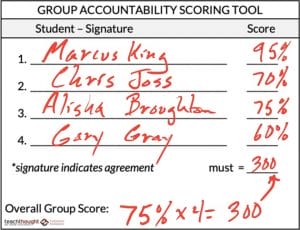
Instead, I like scoring the group as a whole and then giving them a form like the one below where they have to divide the points up according to the work and value added. Those students who did what was expected of them (or more) should get more points than those who didn’t but the total has to add up to the overall group score multiplied by the number of group members.
Again, my goal is to move towards students autonomously managing the process so I suggest having them talk through this process on their own as much as possible. It is important, of course, to modify for age level and situation.
There may be a group member who tries to bully the others or doesn’t have an accurate sense of their contribution and this is where the teacher/facilitator steps in as much as needed to keep problematic conflicts from occurring. Sometimes students will express discomfort with having these hard conversations but I think they’re vital learning opportunities when supported well by the teacher/facilitator.
For younger grades and in some situations you might make them anonymous or other similar modifications but in the end, the idea is that students are rewarded for the work they contributed, including the slackers.
Looking for example contracts? Visit our PBL Workshop Tools and Resources Page, click “Helpful Web Sites and Resources” and search “contracts” in our tagpacker embed
Teaching students in groups has value but just plopping them in 3’s or 4’s without thoughtfulness about how to get the most out of them can lead to resentment and frustration. Instead, consider how you might design for those inevitabilities and create teachable moments for skill-building in addition to the ‘content’ learning you’re hoping to achieve.
If you have ideas or tools you’ve used for group or team work please share!

By Drew Perkins, Director of TeachThought PD


jueves, 1 de agosto de 2019

What UNESCO does on education and gender equality


What UNESCO does on education and gender equality

Gender equality is one of UNESCO’s two global priorities. The organization follows the dual approach of gender mainstreaming and gender-specific programming in targeted programme areas, as outlined in the UNESCO Priority Gender Equality Action Plan (2014-2021).
UNESCO supports Member States to develop education systems that foster high quality and inclusive lifelong learning for all. UNESCO is committed to promoting gender equality in and through education systems from early childhood to higher education, in formal, non-formal and informal settings and in all intervention areas from planning infrastructure to training teachers.
Girls’ and women’s unequal access to, and performance in, education is both a cause and a result of multiple factors, including chronic and systemic gender-based discrimination reproduced in the education system. The over-emphasis on gender parity to measure progress has also led to unsatisfactory results in terms of girls and women’s empowerment through education. The statistics do not show the many types of obstacles that girls and women face, not only in accessing but also in continuing education; nor do they tell much about the quality of learning processes and environment for girls and boys. The failure to analyse the situation through a gender lens has resulted in gender blind and ineffective policies that do little to correct gender inequalities.
UNESCO works to improve the quality of learning processes and environment for girls and boys by fostering gender-sensitive and gender-responsive policies and strategies in education. It aims to move beyond conventional approaches in order to expand access towards a holistic approach that addresses those inequalities in broader society which influence educational opportunities.
UNESCO promotes gender equality throughout the education system including participation in education (access), within education (contents, teaching and learning context and practices) and through education (learning outcomes, life and work opportunities).
Specifically it
  • Monitors progress through the collection and analysis of sex-disaggregated education data and the monitoring of normative instruments related to gender equality;  
  • Helps countries develop their national capacities in mainstreaming gender in educational laws, policies and plans;
  • Supports teacher training in gender-responsive pedagogy that responds effective to the needs of male and female learners;
  • Advocates for girls’ and women’s education through innovative, multisectoral collaborations such as the Global Partnership for Girls’ and Women’s Education, “Better Life, Better Future”;  
  • Seeks to improve and expand girls’ and women’s literacy and their access to formal and non-formal education, including through Information, Communication and Technology (ICT);   
  • Supports the development of curricula and textbooks free from stereotypes and discrimination;  
  • Helps countries address gender-based violence and create safe, inclusive learning spaces that enhance education, well-being and empowerment;
  • Conducts policy research on the barriers to advancing gender equality, and to expand and strengthen the expertise and knowledge base of UNESCO;
  • Collaborates with partners on policy advocacy at global, regional and national levels in support of gender equality in education.
Special attention is given to global advocacy and multisectoral partnerships to promote education for girls and women, in particular through UNESCO’s Global Partnership for Girls’ and Women’s Education “Better Life, Better Future".
Every year the UNESCO Prize for Girls’ and Women’s Education honours outstanding innovation and contributions made by individuals, institutions and organizations to advance girls’ and women’s education. The Prize, which awarded its first laureates in 2016, is unique in showcasing successful projects that improve and promote the educational prospects of girls and women and in turn, the quality of their lives.